
Certified Forward Deployed Engineer (CFDE)™ Associate
A practical, career-focused course for engineers seeking to take responsibility for AI deployments from beginning to end. Delivered over 18 weeks in a structured online cohort, it comprises 15 weekly modules and a three-week capstone. Assessed through marked assignments and a practitioner-marked capstone.
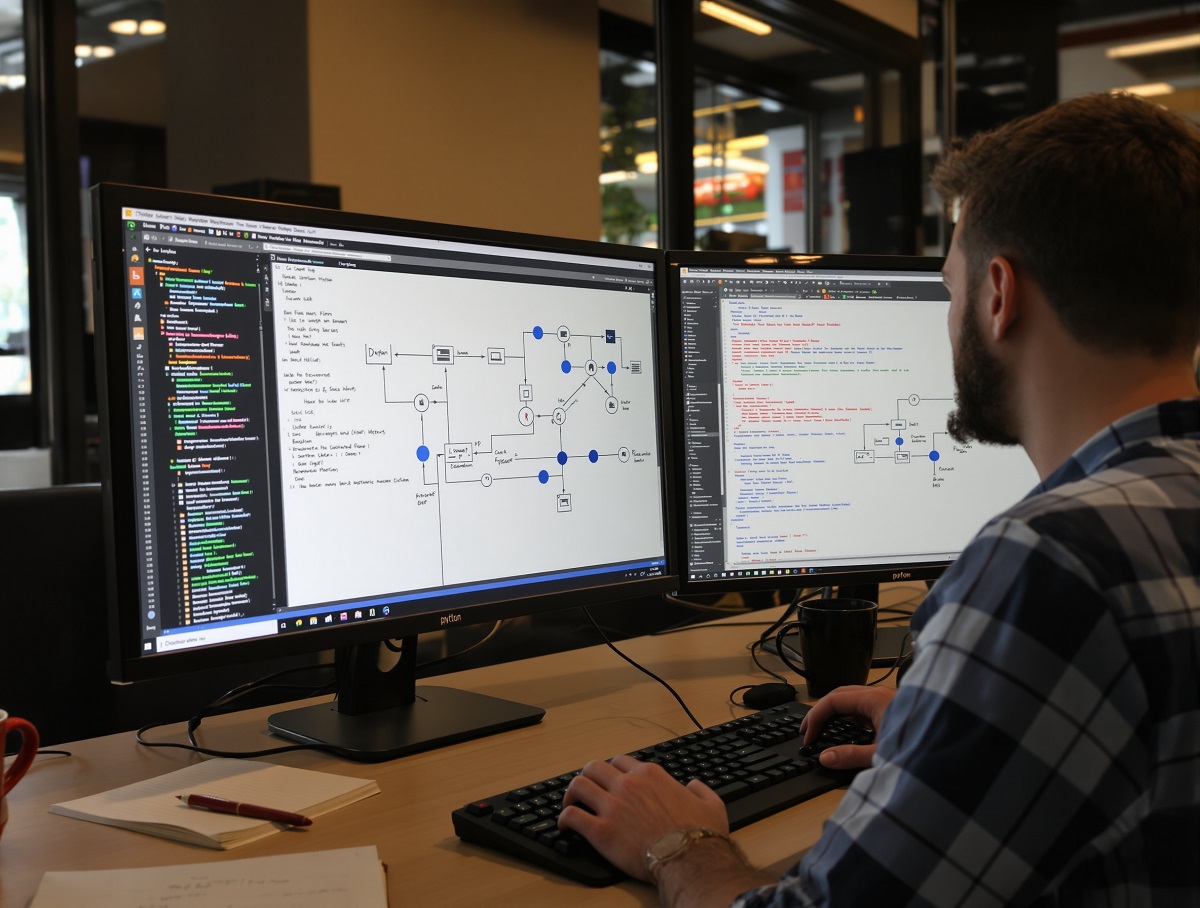
What you will study on CFDE Associate
The CFDE Associate course prepares you for Forward Deployed Engineer roles, in which you take responsibility for an AI deployment from initial discovery through to hand-back. The course provides the knowledge and practical skills; the separate examination certifies them.
At this level, the role encompasses the entire engagement: customer discovery, solution architecture, developing solutions within poorly structured client codebases, integrating APIs and data pipelines, selecting and configuring LLMs, building RAG systems and agents, deploying to production, and handing back to the client team. Throughout, you must also communicate with non-technical stakeholders.
These areas are covered over 18 weeks, comprising 15 weekly modules followed by a three-week capstone.
The January 2027 cohort (2027-C1-CFDE-A) begins on Monday 4 January 2027, with enrolment closing on Sunday 20 December 2026. The course fee is £1,199, which is the full amount payable for the course; no additional course charges are added subsequently. No VAT is charged. The Certified Forward Deployed Engineer (CFDE)™ certification examination is offered separately; its fee is published on the certification page. Eligible applicants may apply for the AIU Access Scholarship rate of £799, subject to the published criteria. Information for applicants whose places are employer-funded is available under Employer funding.
Programme delivery and learning format
The course is delivered online through the AIU learning platform as a structured cohort. Learning combines recorded lectures and course materials with instructor-led discussions and feedback, alongside assignments and a capstone assessed by human reviewers. You should allow approximately eight hours of study per week.
A continuing case study involving a UK facilities-maintenance company runs through the course, from discovery to hand-back. For the capstone, you will undertake a case of your own.
Introductions to the course and individual modules are available on our YouTube channel, Artificial Intelligence Uni (AIU.ac).
Who should consider this course
This course is intended for engineers and technical professionals seeking either to move into Forward Deployed Engineering or to develop further in an existing role. It is relevant to software engineers, data engineers, machine learning engineers, solutions engineers and technical consultants.
Entry requirements and progression
Entry requirements
Before commencing the course, you should be able to:
- write and execute a short Python script;
- use a terminal to navigate between folders and execute commands;
- create basic Git commits;
- read a JSON file and interpret its structure;
- write a straightforward SQL query.
No coding is required in Modules 1 to 3; practical coding begins in Module 4. Before the course starts, Week 0 provides an opportunity to assess your existing skills and directs you to a free learning resource for each one.
Progression
Completion of the CFDE Associate course is a prerequisite for entry to the CFDE Professional course. CFDE Associate certification is also required before you can obtain CFDE Professional certification.
Course syllabus
The syllabus comprises 15 modules, studied one per week, followed by a three-week capstone. Its progression reflects the embedded-engineer model and the successive stages of the deployment lifecycle: post-sale handoff, discovery, scoping, build, deployment, iteration and hand-back.
Module 1Forward Deployed Engineering: Role, Model, and Career
You can explain the Forward Deployed Engineer role, how it differs from related roles, and how success is measured.
Module 2Customer Discovery and Problem Framing
You can plan and run discovery, separate evidence from assumption, and turn it into a clear, testable problem statement.
Module 3Solution Architecture and Technical Documentation
You can turn a scoped problem into testable requirements, a reviewable architecture document and a clear record of design decisions.
Module 4Client Codebases and Legacy Systems Navigation
You can find your way around an unfamiliar codebase and its data, and propose safe changes backed by evidence.
Module 5APIs, Databases, and Data Pipelines
You can connect systems through APIs, choose where data should live, and build a reliable data pipeline.
Module 6Large Language Models: Providers, Selection, and Trade-offs
You can compare language model providers on cost, speed, capability and data handling, and recommend one you can later replace.
Module 7Prompt Architecture for Production Systems
You can design prompts with checked, structured output, keep safety controls outside the model, and test every prompt change.
Module 8Retrieval-Augmented Generation Systems
You can build an assistant that answers questions from a client’s own documents and shows the sources behind each answer.
Module 9AI Evaluation and Testing Frameworks
You can build an evaluation set and choose measures that show whether an AI system is reliable and fit for purpose.
Module 10Agent Development and Orchestration
You can judge when an agent is the right design and build one that asks for human approval before consequential actions.
Module 11AI Operations and Deployment Infrastructure
You can deploy an AI application with automated testing, monitoring and alerts, and keep its running cost under control.
Module 12Model Customisation and Fine-Tuning
You can decide whether fine-tuning or better prompting suits a client’s need, and make a clear technical and commercial case for that choice.
Module 13Production Deployment and Client Adoption
You can plan adoption around real workflows, measure whether it is working, and deliver a documented handover that supports continued use.
Module 14Technical Communication and Stakeholder Management
You can explain technical systems to non-technical people, run productive client meetings and handle scope changes constructively.
Module 15Rapid Delivery and Field Execution
You can break a large, ambiguous problem into one-week milestones, prioritise under pressure and deliver a working first version early.
Capstone, weeks 16 to 18End-to-End Client Engagement Simulation
You take a case of your own through a full client engagement, delivering a capstone report, a working proof and a product-feedback note, assessed by AIU practitioner reviewers.
Develop expertise in AI deployment and practical solution engineering
The eighteen-week programme brings together the following elements:
Comprehensive coverage of the deployment lifecycle
Fifteen weekly modules and a three-week capstone span the complete deployment lifecycle, from post-sale handoff to hand-back. The material draws on engagements across regulated and general industries, while online delivery provides flexibility for practising engineers.
Weekly lessons, practice and marked assessment
Each week includes a short introductory video, three or four written lessons with worked examples, ‘Try it’ exercises using the case company’s materials, a discussion question and a short quiz. Assessed through marked assignments and a practitioner-marked capstone: one written assignment, one hands-on, and a three-week capstone.
Guidance from practitioners
You will have access to weekly practitioner-led discussions and feedback, as well as direct email contact with the admissions and programme team throughout the eighteen weeks.
Learning within an international cohort
You will study alongside engineers from a range of countries and sectors, form study groups, and complete the course with a portfolio that your fellow cohort members have seen take shape.
Frequently asked questions about CFDE Associate
Who is this course intended for?
This course is intended for engineers and technical professionals seeking either to move into Forward Deployed Engineering or to develop further in an existing role. It is relevant to software engineers, data engineers, machine learning engineers, solutions engineers and technical consultants.
When does the next cohort commence?
The January 2027 CFDE Associate cohort (2027-C1-CFDE-A) commences on Monday 4 January 2027. Enrolment closes on Sunday 20 December 2026.
How will my work be assessed?
Assessed through marked assignments and a practitioner-marked capstone. The 18-week course comprises 15 weekly modules followed by a three-week capstone, assessed by AIU practitioner reviewers.
How much time should I allow for studying?
The course is delivered over 18 weeks within a structured cohort, with a recommended study commitment of approximately eight hours per week. You will access recorded lectures and course materials through the AIU learning platform, alongside instructor-led discussions, feedback and assignments assessed by human reviewers.
How does CFDE Associate relate to CFDE Professional and certification?
You must complete the CFDE Associate course before enrolling on the CFDE Professional course, and you must hold CFDE Associate certification to obtain CFDE Professional certification. The Associate course is also highly recommended preparation for the CFDE Associate certification examination. Further information appears under Entry requirements and progression.
What is the application process?
You can apply online at apply.aiu.ac. The application takes approximately ten minutes to complete, and no application fee is charged. If your application is approved, you will receive an offer valid for three days.
Is a fee payable when I apply?
No application fee is payable. The course fee is due when you accept an offer and is refunded in full if your application is not accepted.
Please note: Your application is deemed successful when AIU issues an offer. The offer remains valid for three days, and your place is confirmed upon payment.
Are scholarships available on the basis of financial need?
Yes. The AIU Access Scholarship reduces the course fee to £799 for applicants whose circumstances would otherwise prevent them from taking the course. It is available to nationals of economies classified by the World Bank as low income or lower-middle income, as well as applicants who are currently between roles. Scholarship requests are submitted as part of the course application. AIU assesses each application and makes awards at its discretion; awards are limited and cannot be claimed as an entitlement. A scholarship applies only if it is expressly included in your offer. Please consult the Admissions and Scholarship page for application details.
What capabilities will I develop by completing the course?
You will develop the capabilities required to take responsibility for an AI deployment from beginning to end: conducting customer discovery, designing solution architecture, developing solutions within poorly structured client codebases, integrating LLMs and data pipelines, building RAG systems and agents, deploying to production, and completing a properly documented hand-back to the client team.
Which programming languages and tools will I use?
Python is the principal programming language, alongside SQL (SQLite), JSON, terminal commands and Git. No practical exercise or assignment requires a paid account or service.
Can the course be funded by my employer?
Yes. A sponsorship letter and pro-forma invoice can be provided on request before payment. Employers may pay the fee directly or reimburse the applicant. For further information, see Employer funding or contact admissions@aiu.ac.
What are the cancellation and refund arrangements?
If you cancel within 14 days of payment, you will receive a full refund. After that period, but before the course commences, the fee will be refunded less an £89 administration charge. Once the course has begun, refunds are not available except in exceptional circumstances, at AIU’s discretion. Requests to defer to a later cohort on grounds of hardship may be made up to the end of Week 4. Full terms are set out in the Refund Policy.
Apply to join the January 2027 CFDE Associate cohort (2027-C1-CFDE-A)
Enrolment closes on Sunday 20 December 2026.
UKPRN 10095512 · Company No. 14543918
CERTIFIED FORWARD DEPLOYED ENGINEER CFDE MMXXV® is a registered trade mark of Artificial Intelligence Uni Ltd (UK00004415657).