
Forward Deployed Engineer - Foundation [CFDE-F]
For startups and SMEs. Certifies an engineer who can own AI deployments end to end. 18 weeks in an online structured cohort: 15 weekly modules followed by a 3-week capstone. Assessed by capstone build.
Course fee: £1,099. AIU Access Scholarship: £549 (50% reduction) for applications submitted by 25 October 2026, £769 (30% reduction) by 30 November 2026. Your fee band is confirmed before any payment is requested. There is no separate application fee; the course fee is the only amount payable.
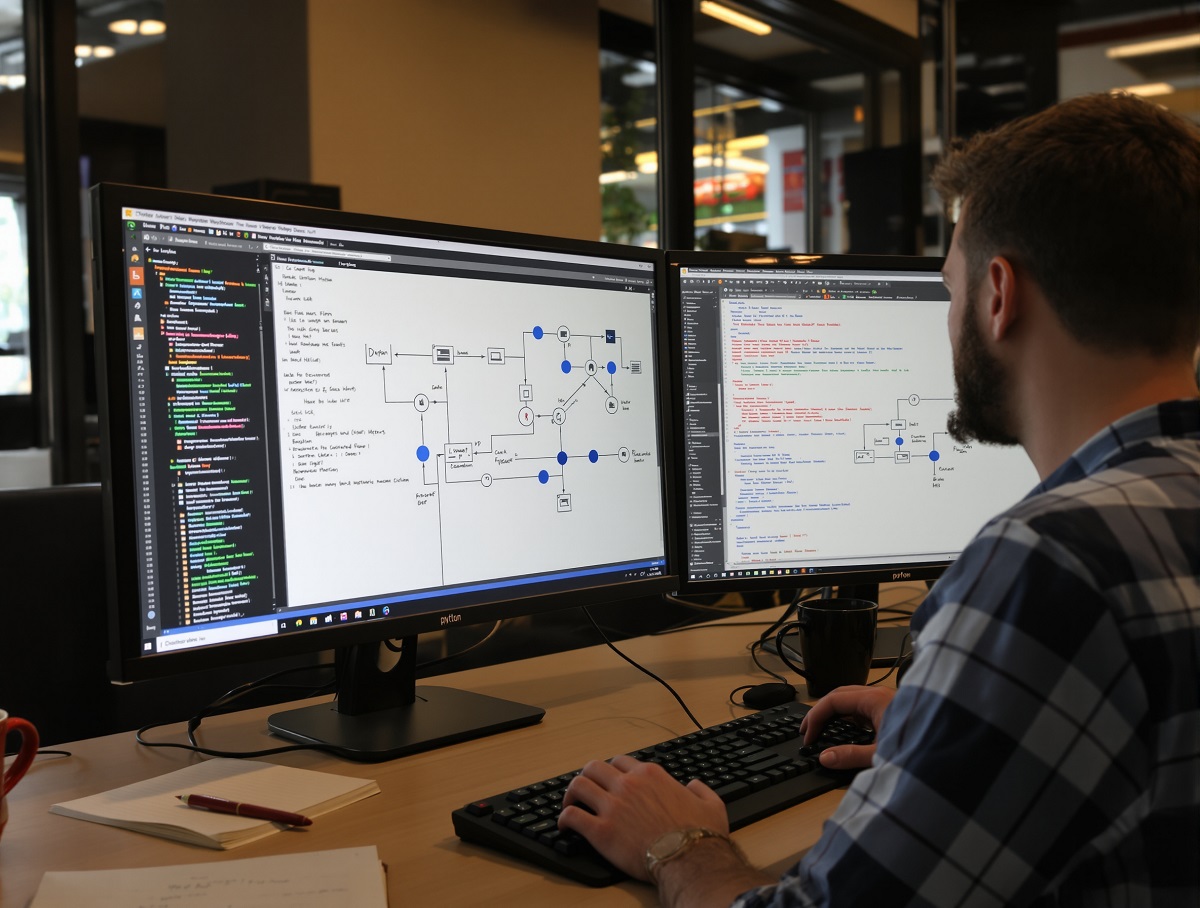
What CFDE-F certifies
Foundation certifies a complete Forward Deployed Engineer. Not a junior version of Professional. Not a stepping stone. This person can own an AI deployment end to end at a startup or SME.
The role at this level means running the whole operation. Customer discovery. Solution architecture. Building on messy client codebases. Integrating APIs and data pipelines. Selecting and configuring LLMs. Building RAG systems and agents. Deploying to production. Handing off to the client team. Communicating with non-technical stakeholders throughout.
Foundation covers all of this across 18 weeks: 15 weekly modules followed by a 3-week capstone, a realistic client engagement simulation where you build a working prototype from a business brief and submit it with your design decisions documented.
The December 2026 cohort commences Monday 14 December 2026. Enrolment closes Monday 30 November 2026.
How the programme is delivered
Delivered online through the AIU learning platform in a structured cohort: recorded lectures and course materials, instructor-led discussion and feedback, and human-marked assignments and capstone. Suggested commitment of approximately 8 hours per week.
Who it is for
Experienced software, data and engineering professionals. The course is open to anyone; we recommend it for software engineers, ML engineers, data engineers, DevOps engineers, and solutions architects who want to move into forward deployed engineering or formalise their existing deployment practice.
The certification exam is a separate product. Examinations open to CFDE Foundation graduates from March 2027, and require 2+ years of relevant experience in software engineering, ML engineering, data engineering, DevOps, solutions architecture, or a closely related discipline. Relevant experience means building and deploying software systems.
Course syllabus
15 weekly modules run one per week, followed by the capstone over three weeks. The sequence follows the FDE deployment lifecycle from first client conversation through production handoff.
Module 1Forward Deployed Engineering: Role, Model, and Career
What the role is and why it exists. How FDEs differ from solutions engineers, consultants, and product engineers. The deployment lifecycle: post-sale handoff, discovery, scoping, build, deploy, iterate, hand-back. How FDEs are measured: deployment velocity, customer success, product feedback quality. Career paths: FDE to Senior FDE to Head of Customer Engineering to founder.
Module 2Customer Discovery and Problem Framing
Running discovery sessions with enterprise and SME clients. Identifying the real blocker when the client cannot articulate it. Asking the right questions before writing a single line of code. Translating vague business pain into a scoped, buildable technical problem. Stakeholder mapping.
Module 3Solution Architecture and Technical Documentation
Translating scoped problems into technical requirements. Writing architecture briefs that a client's CTO or technical lead can review and approve. System design documents. Decision logs that make reasoning visible. Making work handoff-ready.
Module 4Client Codebases and Legacy Systems Navigation
You never start from scratch. How to land in an unfamiliar codebase, understand it quickly, identify integration points, and work within constraints you did not design. Reading undocumented APIs. Working with tribal knowledge. Building on top of messy reality. Ad-hoc exploration using Python, Pandas, SQL, Jupyter to understand the client's data reality.
Module 5APIs, Databases, and Data Pipelines
REST and GraphQL API design and consumption. Connecting systems that were not built to talk to each other. SQL and NoSQL database pragmatism: choosing and justifying the right tool. Vector databases. Production-grade data engineering: building reliable, scalable pipelines that feed AI systems. Data ingestion, transformation, Spark, and Airflow.
Module 6Large Language Models: Providers, Selection, and Tradeoffs
Working across OpenAI, Claude, Gemini, Mistral, and open-source models (Llama, DeepSeek, Qwen). Practical differences in API design, pricing, latency, capability, and compliance posture. Building a model selection framework: when to recommend which provider to a client and justifying the choice on cost, performance, and regulatory grounds. Emphasis on swap-ready architecture over provider lock-in, since the frontier moves fast and named examples date quickly.
Module 7Prompt Architecture for Production Systems
System prompts, structured outputs, chain-of-thought, few-shot learning, guardrails. The difference between a demo prompt and a production prompt: reliability, edge cases, cost, latency. Building prompt systems that hold up when real users do unexpected things. Prompt versioning and regression testing.
Module 8Retrieval-Augmented Generation Systems
Document ingestion, chunking strategies, embedding models, vector databases (Pinecone, Weaviate, ChromaDB), retrieval, hybrid search, re-ranking, generation. Building a complete RAG pipeline against real-world data. The single most common FDE build task in 2026.
Module 9AI Evaluation and Testing Frameworks
Building evaluation suites for AI systems: faithfulness, relevancy, hallucination rate, regression detection, bias, grounding gaps. Automated evaluation vs human evaluation. Evaluation metrics a client can understand and run themselves.
Module 10Agent Development and Orchestration
Agent frameworks: LangGraph, CrewAI, OpenAI Agents SDK, MCP, tool orchestration. The agent loop underlying all of them: plan, act, observe, repeat. Single-agent and multi-agent system design. When to use agents vs when a simpler pipeline is better. Multi-agent orchestration, human-in-the-loop patterns, and agent failure modes at the Foundation level.
Module 11AI Operations and Deployment Infrastructure
CI/CD pipelines for AI applications. Monitoring, observability, alerting. Cost optimisation: token budgeting, caching, model routing. Deploying on Vercel, Railway, AWS Lambda, or lightweight cloud infrastructure. Model versioning and experiment tracking. Environment management with Docker and cloud CLIs. Scoped to what an SME FDE actually does.
Module 12Model Customisation and Fine-Tuning
When to fine-tune vs prompt-engineer. Making the business case to a client. LoRA/QLoRA. Training data curation and quality. Evaluation gates before deploying a fine-tuned model. Version control for models. Cost implications and tradeoffs.
Module 13Production Deployment and Client Adoption
Getting from working demo to live production. The 80% of work that happens after the demo works. Onboarding client teams to use the deployed system. Reducing resistance by tailoring to real workflows rather than forcing workflow changes. Measuring adoption. Defining success metrics with the client. Handoff documentation.
Module 14Technical Communication and Stakeholder Management
Explaining technical architecture to non-technical people. Running effective client meetings. Status updates that build trust. Managing scope creep and setting expectations. Saying no constructively. Written communication: implementation guides, decision logs, handover documentation.
Module 15Rapid Delivery and Field Execution
The FDE's core thinking skill. Taking a massive, ambiguous problem and breaking it into shippable chunks. Prioritisation under time pressure without sacrificing production quality. Making and documenting assumptions. Shipping MVPs that are genuinely viable. Breaking work into 1-week milestones. Delivering a walking skeleton early. Problem decomposition and MVP prioritisation.
Module 16Capstone: End-to-End Client Engagement Simulation (3 weeks)
Realistic engagement simulation running over three weeks. You receive a business brief from a mock client with ambiguous requirements, a messy dataset, and a tight deadline. Deliverables: discovery notes, architecture document, working deployed prototype, client-facing documentation, and a written record of the design decisions you made and why. Assessed by AIU practitioner reviewers against a published rubric covering whether the solution works, whether the code is handoff-ready, whether you solved the right problem, and the quality of your written technical communication.
Fees and the AIU Access Scholarship
Course fee: £1,099. Fees are in pounds sterling. There is no application fee. The programme fee is payable on application, after your scholarship band (if applicable) has been confirmed, and is refunded in full if your application is not accepted.
A limited number of scholarship places reduce the course fee. You are eligible if you are a national of an economy classified by the World Bank as low income or lower-middle income, or if you are currently between roles. Nationals of eligible economies living elsewhere may apply by certifying current financial hardship or unemployment. The reduction is the same whichever basis applies. Your fee band is confirmed before any payment is requested. As part of a scholarship application you will be asked to describe your circumstances briefly and to sign a declaration; documentary proof may be requested.
| Application submitted | Scholarship fee |
|---|---|
| 7 October 2026 to 25 October 2026 | £549 (50% reduction, tier 1) |
| 26 October 2026 to 30 November 2026 | £769 (30% reduction, tier 2) |
Your tier is fixed by the date and time you submit your application (23:59 UK time on the closing day). Eligibility is confirmed before you are asked to pay. Awards are limited and are not guaranteed. The scholarship applies to the course fee only.
How the application works
Step 1
Apply
Complete the application on this site. It takes about ten minutes. Indicate whether you are applying for the AIU Access Scholarship.
Step 2
Fee band confirmed
We confirm your fee band, normally within 2 working days, and send you a secure payment link. The link is valid for 7 days, and payment must in any case be received by 30 November 2026.
Step 3
Pay and hold a provisional place
Pay the fee. You receive a provisional place immediately, with a receipt and your application reference.
Step 4
Verification
We verify your application, including an identity check, within 5 working days.
Step 5
Confirmed
On confirmation you receive your admission letter with your roll number and section. If we are unable to confirm your place, your fee is refunded in full within 5 working days.
Before the cohort
Course access
No course access or materials are provided before the commencement date of 14 December 2026.
Employer sponsorship
We issue a sponsorship letter and a pro-forma invoice on request before payment. Your employer may pay directly, or you may pay and be reimbursed against an invoice issued in your name. Refunds are always issued to the original payer. Contact admissions@aiu.ac.
Refunds
There is no application fee. The programme fee is refunded in full if your application is not accepted, or if you cancel within 14 days of payment. Cancellations after 14 days and before 14 December 2026 are refunded less a £77 administration fee. No refunds are made from the commencement date. In cases of hardship, deferral to a later cohort may be requested by the end of week 4, subject to availability. Full details are in the Refund Policy.
Dates
| Applications open | 7 October 2026 |
| Scholarship tier 1 closes | 25 October 2026, 23:59 UK |
| Scholarship tier 2 closes | 30 November 2026, 23:59 UK |
| Enrolment closes | 30 November 2026, 23:59 UK |
| Cohort commences | 14 December 2026 |
FAQs
Who is the Foundation course for?
Software engineers, ML engineers, data engineers, DevOps engineers, and solutions architects who want to move into forward deployed engineering or formalise their existing deployment practice. The course is open to anyone. The certification exam requires 2+ years of relevant experience in software engineering or a closely related discipline.
When does the cohort start?
The December 2026 cohort of CFDE Foundation commences on Monday 14 December 2026. Applications are open now; enrolment closes Monday 30 November 2026.
What is the time commitment?
18 weeks in a structured cohort. Suggested commitment of approximately 8 hours per week. Content is delivered through recorded lectures and course materials on the AIU learning platform, with instructor-led discussion and feedback and human-marked assignments.
Is there an application fee?
No. The programme fee is payable on application, after your scholarship band (if applicable) has been confirmed, and is refunded in full if your application is not accepted.
Is a scholarship available?
Yes. The AIU Access Scholarship offers a limited number of fee reductions for nationals of economies classified by the World Bank as low income or lower-middle income, and for applicants currently between roles. Tiers, dates and eligibility are set out on this page.
Can my employer fund this programme?
Yes. We issue a sponsorship letter and a pro-forma invoice on request before payment. Employers may pay directly or reimburse the applicant. Contact admissions@aiu.ac.
What information do you ask for?
The application asks for your contact details, country of residence, LinkedIn profile, and professional background. If you apply for the AIU Access Scholarship, you will also be asked for your country of nationality, a brief statement of your circumstances, and a signed declaration; documentary proof may be requested. We do not ask for date of birth, photograph, marital status, religion or health information. See the Privacy Policy for how your data is used and retained.
What happens if I apply after enrolment closes?
Applications received too late to be banded and paid by 30 November 2026 are considered for the February 2027 cohort.
What is your refund policy?
Applications that are not accepted are refunded in full. Cancellations within 14 days of payment are refunded in full. Cancellations after 14 days and before the cohort commences are refunded less a £77 administration fee. No refunds are made from the commencement date. In cases of hardship, deferral to a later cohort may be requested by the end of week 4, subject to availability. Full details are in the Refund Policy.
Before you apply, please read the Terms and Conditions, the Refund Policy, the Privacy Policy, and the Non-Discrimination Policy. You will be asked to confirm that you have read and accept them. Your application is timestamped in UK time on submission; that timestamp fixes your scholarship tier.
CFDE Foundation, December 2026 cohort
Applications are open. Enrolment closes Monday 30 November 2026. There is no application fee.
Artificial Intelligence Uni · UKPRN 10095512 · Artificial Intelligence Uni Ltd · Company #14543918